Garage Door Sizes by Vehicle: What Fits Your Car, SUV, Truck or Van?
Every garage door sizes chart answers the builder’s question — what sizes exist. The question in the driveway is the owner’s one: will my vehicle go through the door I have? A 7-foot door clears 84 inches of height, and a full-size pickup stands 78.5 — so the honest answer is usually yes, with the exceptions named and measured rather than guessed.
The full standard chart is here — sizes, clearances and measuring rules — and after it comes the matching the charts leave undone: seven named vehicles, taken from their makers’ own specification sheets, set against the standard doors — plus the vans and motorhomes that genuinely outgrow them.
Heights are the binding constraint, so heights lead. Widths are checked with mirrors folded and unfolded, because that is where the close calls live.
Standard Garage Door Dimensions
Residential doors are stocked in a fixed ladder of widths — Clopay, the largest maker, publishes 8, 9, 10, 12, 14, 15, 16 and 18 feet — at a standard height of 7 feet, with 8 feet widely stocked. The named size is the finished opening: Clopay’s installation manual states that the rough opening should be the same size as the door, so a “9 × 7 door” is a 9-foot-wide, 7-foot-tall hole in the wall, filled exactly.
The door itself is built from horizontal sections of 18, 21 or 24 inches — a 7-foot door usually stacks four sections of 21 inches. Around the opening, three clearances decide whether a door can work at all: headroom above it (12 inches for torsion springs, 10 for extension springs, plus 2 to 3 more when a trolley opener is fitted), sideroom beside it (3¾ inches minimum per side, 5½ with EZ-Set hardware), and backroom behind it (the door’s height plus 18 inches of depth — 8 ft 6 in when the door stands 7 feet). Track built for low headroom works down to roughly 4½ inches; high-lift track asks for the lift height and about 9½ inches more.
Garage Door Sizes by Vehicle: The Fit Table
Seven vehicles, spanning the American driveway from sedan to full-size pickup, with dimensions taken from each maker’s published specifications. The verdicts use the clear opening of the smallest standard door that fits — height against the 7-foot door’s 84 inches, width against the 8-foot door’s 96.
| Vehicle | Height (maker’s figure) | Width, mirrors excluded | Fits | Height to spare under 7 ft |
|---|---|---|---|---|
| Toyota Camry | 56.9 in | 72.4 in | Any standard door | 27.1 in |
| Tesla Model Y | 63.8 in | 75.6 in | 8 × 7 ft | 20.2 in |
| Honda CR-V | 66.2 in | 73.5 in | 8 × 7 ft | 17.8 in |
| Toyota RAV4 | 68.6 in (with roof rails) | 73.0 in | 8 × 7 ft | 15.4 in |
| Jeep Wrangler | 73.6 in | 73.9 in | 8 × 7 ft | 10.4 in |
| Chevrolet Tahoe | 76.3 in | 81.0 in | 8 × 7 ft — fold the mirrors | 7.7 in |
| Ford F-150 Lightning | 78.5 in | 80.0 in | 8 × 7 ft — fold the mirrors | 5.5 in |
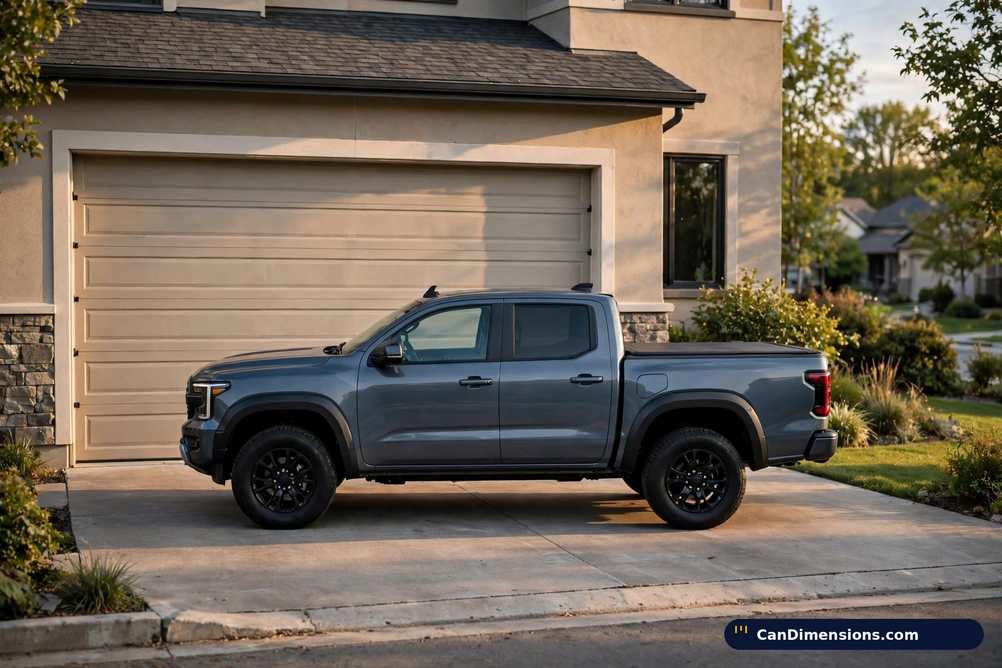
Read the mirror column’s fine print in the rows where it matters. The Model Y measures 83.8 inches across its unfolded mirrors — still inside a 96-inch doorway, so it drives through an 8-foot door mirrors-out. The Tahoe’s mirrors span 93.6 inches: through a 96-inch opening that leaves 2.4 inches in total, a hand’s breadth split two ways — fold them. The F-150 is the extreme: 96.0 inches across the mirrors is the doorway’s exact width, which is no clearance at all; folded, at 83.6 inches, it has 12.4 inches to spare. Every height in the table, meanwhile, clears the 7-foot door — even the tallest pickup keeps 5.5 inches in hand.

Single-Car Garage Door Dimensions
The single door comes in two standard widths: the classic 8 × 7 feet of older homes and the 9 × 7 that newer builds fit most often, with 10-foot widths stocked for generous singles. Against the fit table, the difference between 8 and 9 feet is not about the vehicle — every car and SUV in the table fits the 8-foot width on its body — it is about mirrors and margin: the extra foot buys mirror clearance for the big SUVs and pickups, and door-swing room once parked.
Height is uniform across singles at 7 feet, and 84 inches swallows the whole table. The single-door buyer with a standard vehicle is choosing elbow room, not clearance.
Two-Car Garage Door Dimensions
The standard double is 16 × 7 feet, with 18-foot widths and 8-foot heights stocked for larger garages. Sixteen feet of width is the number the next section stress-tests; on height, the double is the single’s equal — 7 feet standard — and the fit table’s verdicts carry over unchanged: nothing in the seven needs the 8-foot height, and everything with folded mirrors fits the width with room to work.
Two Vehicles Side by Side: What a 16-Foot Door Really Swallows
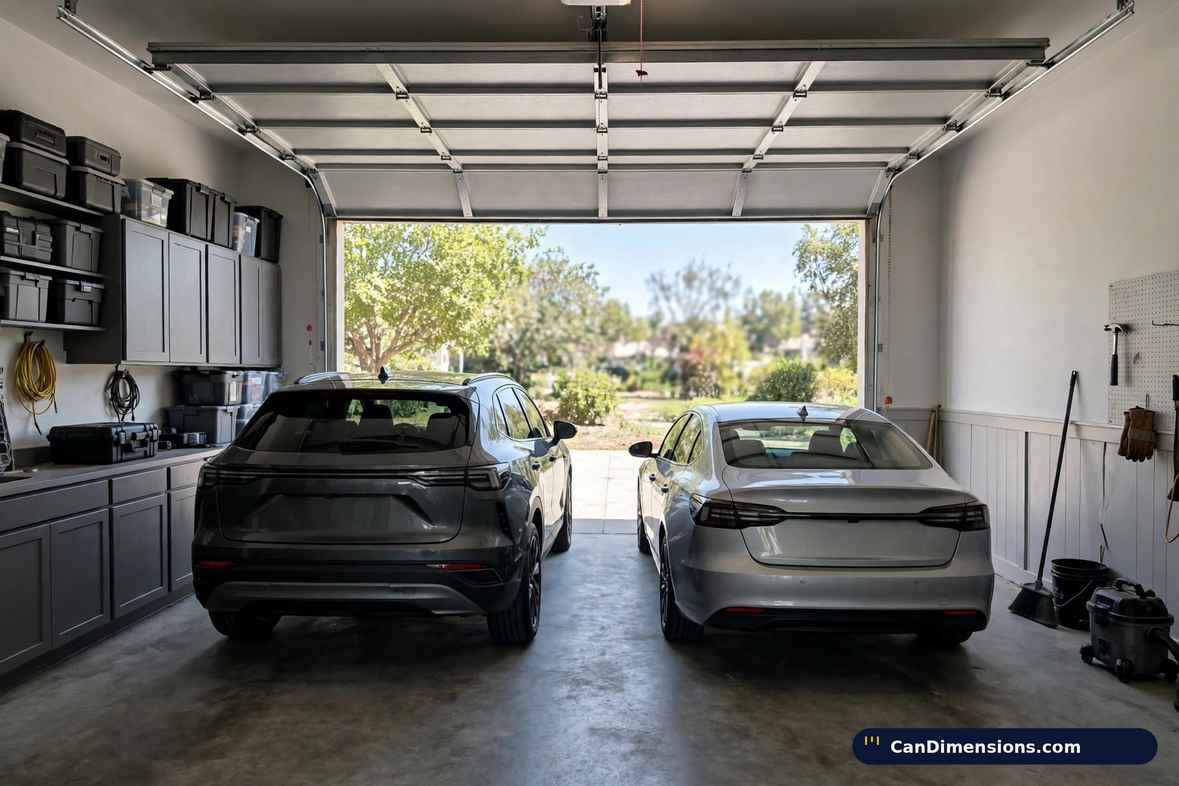
Pair the two widest vehicles in the table: a Tahoe at 81.0 inches and an F-150 at 80.0 total 161 inches of vehicle inside the 16-foot door’s 192 inches — 31 inches of spare width, which split across the three gaps (wall, middle, wall) is about 10 inches a gap. Workable, and noticeably tighter than the brochure photograph suggests. Pair two RAV4s instead — 73.0 inches each, 146 in total — and the same doorway returns 46 inches of spare, over 15 inches a gap. The door did not change; the pairing did.
Inside, the conventional two-car garage is 20 × 20 feet (a building convention, not a code — no national standard fixes garage interiors). Length is the quieter squeeze: the F-150 at 231.7 inches is 19.3 feet long, so a 20-foot-deep garage closes on it with about 8 inches behind the tailgate. Our guide to how far is 20 feet gives that depth a human scale, and the footprint comparison is worth making once: 20 × 20 feet is a generous living room’s floor — the average living room dimensions are the same class of rectangle, asked to hold furniture instead of trucks.
Specialty Garage Door Sizes
Beyond the residential ladder sit the doors sized by their vehicles from the start. Golf-cart doors are the small class — 5 to 6 feet of width, 6 to 7 of height, with 5 × 7 and 6 × 7 the common pairings — a door class below the car ladder entirely. RV and motorhome doors span a typical band of 10 to 14 feet wide by 12 to 14 tall: a 12 × 12 opening takes most Class C motorhomes, and 14 × 14 is the common Class A choice. Commercial doors start at 10 × 10 service bays, run through 12 × 12 and 12 × 14 dock configurations, and reach 20 feet and wider for warehouses. These are dealer-guide consensus bands rather than one maker’s chart — no single manufacturer publishes the specialty ladder — and they are printed as typical ranges for that reason.
The Height Test: Why 7 Feet Fits Almost Everything on the Road
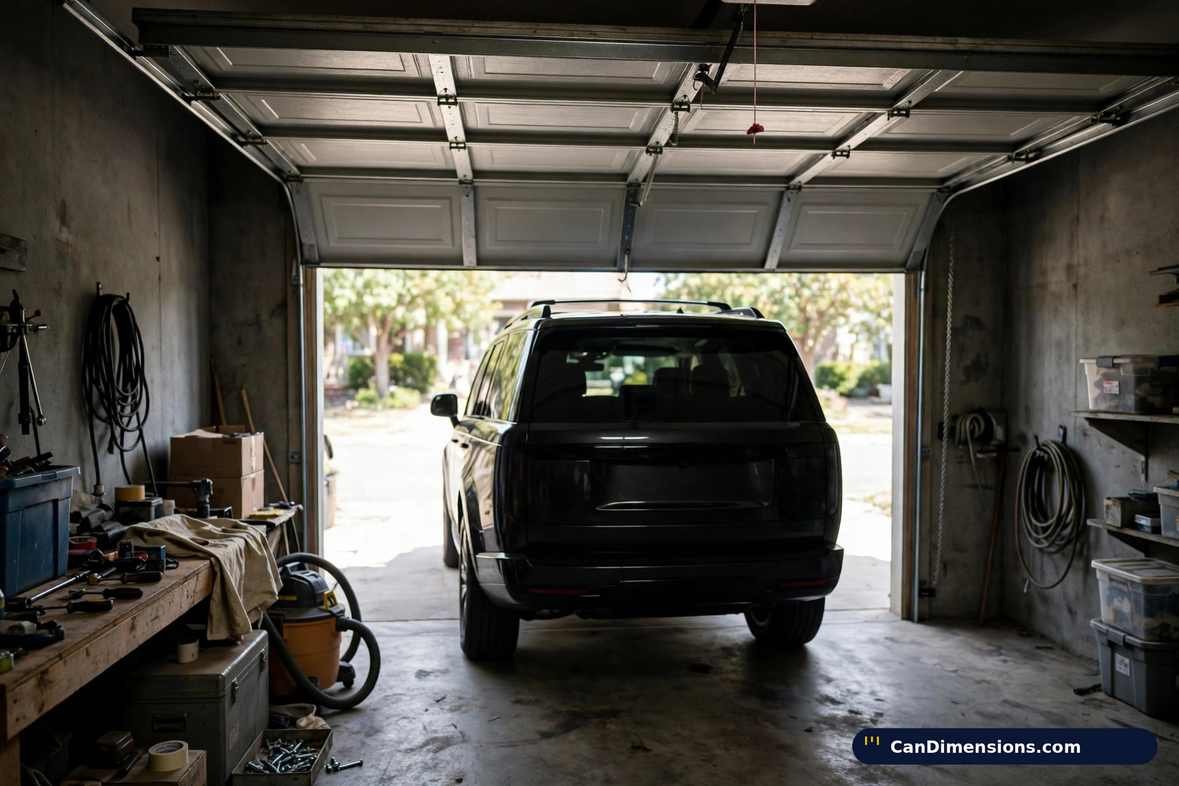
Eighty-four inches is a taller line than it sounds. The tallest vehicle in the fit table, a full-size electric pickup, stands 78.5 inches; the tallest SUV keeps 7.7 inches in hand; the Wrangler, the vehicle people most often worry about, clears by 10.4. Sedans are not in the conversation at all — a Camry leaves 27.1 inches standing empty above it, nearly half its own height again.
The exceptions are real but specific, and they share a shape: things added above the roofline, and vans. A roof box, a ladder rack or a lift kit spends the spare inches the maker left — the only honest procedure is to measure the vehicle as it actually stands, box fitted and tyres inflated, against the 84-inch line. And one stock vehicle genuinely grazes the line: Ford’s low-roof Transit van stands 83.6 inches, which clears a 7-foot door by 0.4 inches — a fit on paper that no one should rely on in a real driveway, with real suspension travel and a real threshold. For everything taller, the ladder’s next rung is the 8-foot door: 96 inches, four inches short of our 100 inches reference — and enough for every stock passenger vehicle made.
When the Vehicle Outgrows the Door
Ford’s Transit makes the cleanest case study, because one vehicle spans the whole ladder. The low roof stands 83.6 inches — the 0.4-inch paper fit above. The medium roof stands 100.8 inches: past the 8-foot door’s 96, and into a 9-foot door (108 inches) with 7.2 inches to spare. The high roof stands 110.1 inches: past the 9-foot door too, and into a 10-foot door (120 inches) with 9.9 inches in hand. Same van, three roofs, three door sizes — the chart in one vehicle.
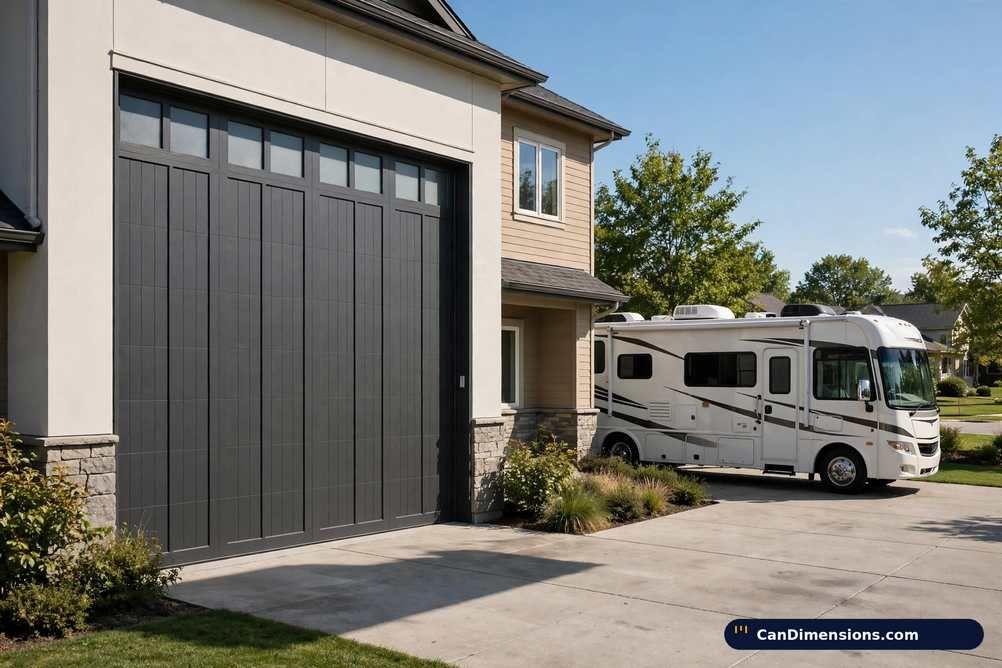
Motorhomes outgrow residential doors altogether and take the specialty band: 12 × 12 feet for most Class C rigs, 14 × 14 for Class A — a door that stands a foot short of 15 feet in both directions, and the largest opening most homes ever frame. Lifted trucks join the list by modification rather than manufacture: a lift and taller tyres add their inches to the maker’s height figure, and the fit-table verdict expires with the first modification. Measure the truck as it stands; the spec sheet no longer describes it.
How to Measure Your Garage Door Opening
Measure the finished opening, not the old door: width across the inside of the frame at its widest, height from the floor to the header’s underside. The door you order is that opening’s size — Clopay’s manual is blunt about it: “the rough opening should be the same size as the door.”
Then measure the three clearances the opening hides. Headroom: from the top of the opening to the ceiling or the lowest obstruction — 12 inches wanted for torsion springs, 10 for extension, plus 2 to 3 if a trolley opener is planned. Sideroom: the gap from each side of the opening to the closest wall — 3¾ inches minimum, 5½ for EZ-Set extension hardware. Backroom: from the opening back into the garage — the door’s height plus another 18 inches, which is 102 inches of depth behind a 7-foot door, more with an opener. Finish by measuring the vehicle the same way this page does: height at its tallest point as it stands, width across the mirrors both ways. Opening, clearances, vehicle — three measurements, and every verdict in the fit table can be re-run for any vehicle on the road.
FAQ’s
What are standard garage door dimensions?
Singles are 8 × 7 or 9 × 7 feet; the standard double is 16 × 7. Makers stock widths of 8, 9, 10, 12, 14, 15, 16 and 18 feet, with 7 feet the standard height and 8 feet widely stocked.
What is the size of a 2 car garage door?
16 × 7 feet is the standard — 192 inches of width, 84 of height. Wider doubles run to 18 feet, and 8-foot heights are stocked.
How many centimeters is a 2 car garage door?
16 feet is 487.68 cm — which rounds to 488 cm, not the truncated 487 some charts print — and 7 feet is 213.36 cm. A standard double is 487.68 × 213.36 cm.
What is the size of a 1.5 car garage in feet?
There is no 1.5-car door in the makers’ ladder; the in-between widths are the stocked 10 and 12 feet, at the standard 7 feet tall. A “1.5-car” garage takes one of those.
What’s better, a 1¼ or ¾ garage door opener?
For most doors, neither is working hard: the springs counterbalance about 90–95% of the door’s weight. Maker guidance rates ½ HP for doors to about 300 lb and ¾ HP for heavy doubles to about 500 lb, with 1¼ HP reserved for the heaviest doors — the claim that anything over 200 lb needs 1¼ HP is not in the makers’ guidance.
How wide is a normal 2 car garage?
The conventional two-car garage is 20 feet wide by 20 deep — a building convention rather than a code — which leaves a clear width of roughly 18 to 20 feet once the walls are counted.
What is the most common garage size?
The 20 × 20 foot two-car garage is the conventional standard, and its most common door is the 16 × 7. For singles, 9 × 7 is the most common door on newer homes; 8 × 7 is the older classic.
Are most doors 32 or 36 inches?
For house entry doors, 36 inches is the standard width; 32 inches serves as the common interior and secondary width. (Garage vehicle doors, this page’s subject, are measured in feet.)
What is the size of a standard garage door in meters?
A 16 × 7 ft double is 4.88 × 2.13 m; a 9 × 7 single is 2.74 × 2.13 m; the classic 8 × 7 single is 2.44 × 2.13 m.
Conclusion
The garage door sizes chart and the driveway agree more often than owners fear: the standard ladder — 8 and 9 feet for singles, 16 for doubles, 7 feet of height over all of it — was drawn around the vehicles it serves, and the makers’ own figures show every ordinary car, SUV and pickup clearing it, mirrors folded where the table says to fold them. The true exceptions are vans, motorhomes and modified trucks, and each has its rung on the ladder waiting.
And for the vehicle that still will not fit — the high-roof van, the lifted truck, the third car — the older solution stands beside the garage rather than in it: a carport, open-sided and doorless, asks no height of anything. Measure first; the numbers, as ever, settle it.