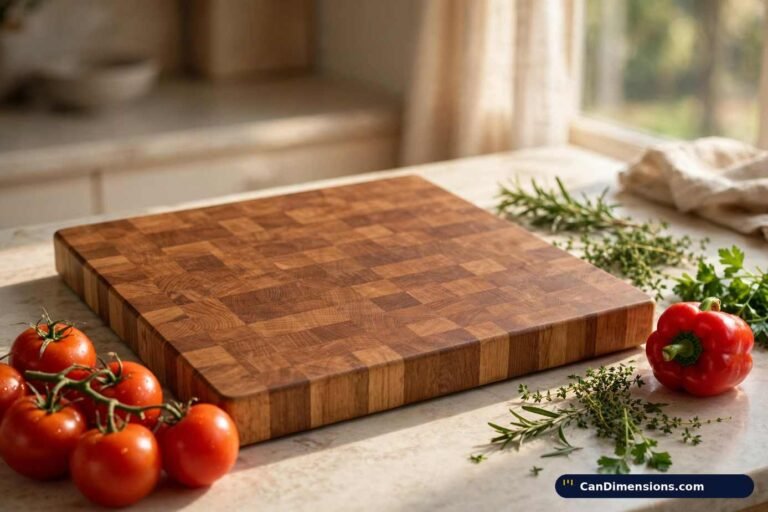
How Much Is 3 Ounces? 13 Common Things That Weigh 3 Ounces
Three ounces is one of those weights that recipes, portion guides and shipping labels use constantly, yet very few people can actually picture it. So how much is 3 ounces, really? It is exactly 85.05 grams — three sixteenths of a pound — and this page pins it down with exact conversions and real, checked objects.
The confusion starts with the word ounce itself, because a fluid ounce measures volume while an ounce measures weight, and the two only agree for water. Every figure below keeps the two apart, and every example object has been checked against a mint specification, a manufacturer label, a standards table or a food database before it was counted.
You will find the exact conversions first, then 13 everyday things that genuinely weigh 3 ounces — including three famous examples that fail the check and are corrected in place under their original headings. A no-scale measuring section, a short myth check and plain answers to the common questions follow.

What Is 3 Ounces?
An ounce is a unit of weight in the imperial and US customary systems. One ounce is defined as exactly 28.349523125 grams, so 3 ounces is exactly 85.0486 grams — printed as 85.05 g everywhere on this page. There are 16 ounces in a pound, which makes 3 ounces exactly 0.1875 lb, or three sixteenths of a pound.
The quick picture: 3 ounces is roughly the weight of a tangerine, three quarters of a stick of butter, or a palm-sized portion of cooked chicken. It sits on the same ladder that starts with things that weigh 1 gram — eighty-five of those gram steps, gathered into one small handful.
One warning before the conversions. Precious metals are weighed in a different unit, the troy ounce of 31.1035 grams, so “3 ounces” of gold or silver is 93.31 grams, not 85.05. Everything else on this page uses the ordinary avoirdupois ounce — the one on kitchen scales, food labels and coin specifications.
Quick 3 Ounces Conversion Reference Table
| Conversion | Value | Type |
|---|---|---|
| Grams | 85.05 g | Weight |
| Kilograms | 0.085 kg | Weight |
| Milligrams | 85,049 mg | Weight |
| Pounds | 0.1875 lb | Weight |
| Stones | 0.01339 st | Weight |
| Carats | 425.2 ct | Weight |
| Grains | 1,312.5 gr | Weight |
| Troy ounces | 2.734 troy oz | Weight |
| Millilitres | 88.72 mL | Volume (fluid ounces) |
| Cups | 3/8 cup | Volume (fluid ounces) |
| Tablespoons | 6 tbsp | Volume (fluid ounces) |
| Teaspoons | 18 tsp | Volume (fluid ounces) |
How Heavy Is 3 Ounces?
Three ounces is light but noticeable — about the heft of a tangerine in the palm, or a bar of soap in the hand. It is far too heavy to be a letter and far too light to be a phone: a typical smartphone weighs about twice as much. Postal scales notice it, kitchen scales measure it easily, and a bathroom scale cannot see it at all.
Set against its neighbours, 3 ounces is a little over halfway from what weighs 100 grams — exactly 85% of it — three times a single ounce of cheese on a sandwich, and three quarters of a quarter-pound patty before cooking. It is also the standard cooked serving for meat and poultry in US portion guidance, which is why this particular weight shows up on so many plates.
How Much Is 3 Ounces? 13 Common Things That Weigh 3 Ounces
Every example under this heading was checked before it was counted. Thirteen pass — some exactly, on a specification or a label, and some as honest “about” matches on an official average. Three of the original examples fail, and they stay below as corrected warning sections, clearly marked, so nobody repeats them.
| Thing | Verified weight | Counted? |
|---|---|---|
| Half a small chicken breast | ≈85–86 g (USDA reference basis) | Yes — about |
| A bar of soap (full-size, labelled) | 90 g / 3.17 oz (label) | Yes — about |
| Contents of a 3 oz spice jar | 85 g (label net weight) | Yes — exact, contents only |
| Two small eggs (in shell) | 3.0 oz (USDA class average) | Yes — class basis |
| Fifteen US quarters | 85.05 g (Mint spec) | Yes — exact |
| Seventeen US nickels | 85.0 g (Mint spec) | Yes — about |
| Thirty-four US pennies | 85.0 g (Mint spec) | Yes — about |
| Three-quarters of a stick of butter | 3 oz (label) | Yes — exact |
| 85 millilitres of water | 85.05 g (by definition) | Yes — exact |
| A 3 oz calibration weight | 85.05 g (certified) | Yes — exact |
| A tangerine (medium) | 88 g (USDA) | Yes — about |
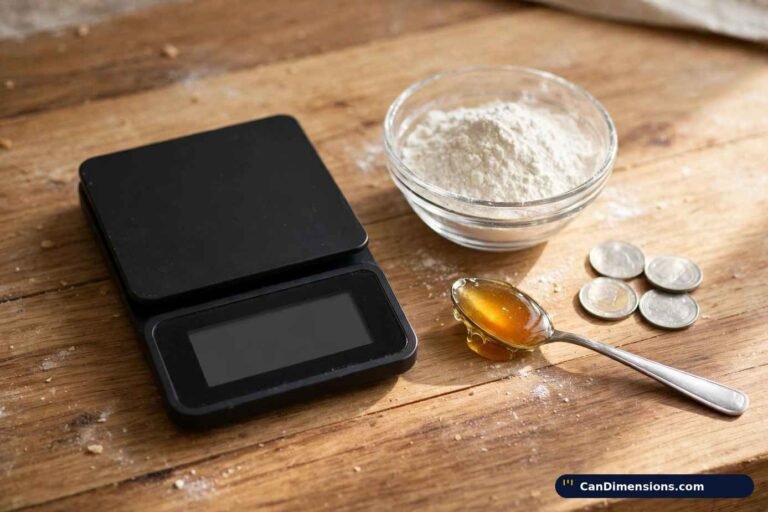
| A quarter cup of honey | 84 g (USDA) | Yes — about |
| A Logitech G203 gaming mouse | 85 g (manufacturer spec) | Yes — about |
| Two large eggs | ≈113 g in shell (4 oz) | No — corrected below |
| Twelve US quarters | 68.04 g (2.4 oz) | No — corrected below |
| A standard lime | 67 g (USDA) | No — corrected below |
Two Large Eggs
Not counted: two large eggs weigh about 4 ounces in their shells, not 3. US egg sizes are set by minimum weight per dozen, and the USDA’s Large class is 24 ounces per dozen — an average of 2.0 ounces (56.7 g) per egg, shell included. Two of them make 113.4 g, a full ounce over the mark. The claim fails even with the shells off: the edible contents of a large egg run about 50 grams, so two shelled eggs are about 100 g, roughly 3.5 ounces. The “1.6 oz per egg” figure behind this claim matches no USDA class and no USDA egg record. The honest two-egg match for 3 ounces is a different class entirely — it is the two small eggs a few sections down.
Half a Small Chicken Breast
Counted: about 3 ounces — on the USDA reference basis, stated plainly. The USDA’s standard reference record lists a boneless, skinless chicken breast piece at 170 grams raw, so half of that reference breast is 85 grams — 3 ounces on the nose. Its cooked record agrees from the other direction: the listed portion for half a roasted breast, bone and skin removed, is 86 grams. Two honest limits come with the count. First, there is no fixed “half a breast” weight — the USDA’s newer average retail piece runs 272 grams, and half of one of those is 136 grams, nearly 4.8 ounces. Second, raw and cooked weights differ: a 3-ounce cooked portion starts as roughly 4 ounces raw. Counted for a genuinely small breast at the reference size — which is also why 3 ounces of cooked chicken breast, about 26 grams of protein, is the standard palm-sized serving.
A Bar of Soap
Counted: about 3 ounces — on the labelled weight of a standard full-size bar. The common bath bar on US shelves is labelled 90 grams, which the same label prints as 3.17 oz — about 6% over the mark, and the closest standard bar there is. Two parts of the usual claim need correcting. Travel and guest bars are not the 3-ounce reference: hotel-size bars typically run about 1 ounce. And the TSA’s 3.4 fl oz rule has nothing to do with soap bars — it limits liquids and gels in carry-on bags; a solid bar is not measured by it at all. Hold a full-size labelled bar and your hand knows 3 ounces, plus a small fraction.
A Small Jar of Spices
Counted — exact, contents only: the spice inside a jar labelled “NET WT 3 OZ (85 g)” weighs exactly 3 ounces. Garlic powder is the easy shelf example: Badia sells an organic garlic powder in a 3 oz bottle, Amazon’s own grocery line sells a fine garlic powder at 3 oz, and The Spice House lists its granulated garlic at a 3 oz product size. A US net-weight label is a legal statement about the contents, so the figure is verified by the label itself. Two cautions. The jar and lid are packaging and are not counted — a filled jar on a scale reads well over 3 ounces. And net weights are exact label statements, not the loose “2 to 3 oz” ranges sometimes printed for whole spice categories: a jar says 3 oz, or it says something else.
Twelve US Quarters
Not counted: twelve US quarters weigh 68.04 grams — 2.4 ounces, not 3. The US Mint specification for a quarter is 5.670 grams, and 12 × 5.670 g = 68.04 g. The claim fails on its own numbers, too: a quarter is sometimes rounded to “0.2 oz,” and 12 × 0.2 oz is still only 2.4 oz. This is the most repeated wrong figure on pages like this one, because the stack looks like it should reach a round number. It does not. The stack that actually works is fifteen quarters — a few sections below — and the measuring section further down repeats this correction where the trick is usually taught.
A Standard Lime
Not counted: a standard lime weighs about 67 grams — 2.36 ounces, not 3. The USDA’s reference lime, one fruit of 2-inch diameter, is listed at 67 g (FDC 168155). That is the standard fruit a grocery lime is graded against, and it falls more than half an ounce short; you would need about one and a quarter standard limes to reach 3 ounces. The companion claim, that a lemon runs 3 to 4 ounces, overshoots in the other direction: the USDA’s reference medium lemon is 58 grams, barely 2 ounces. Citrus is a fine handful reference for roughly two and a half ounces. For 3 ounces, use the tangerine below instead.
Two Small Eggs
Counted: two small eggs in their shells average 3.0 ounces — on the USDA class basis. Egg sizes are minimum weights per dozen, and the Small class is 18 ounces per dozen, which works out to an average of exactly 1.5 ounces — about 42.5 grams — per egg, shell included. Two of them average 3.0 ounces. Individual eggs vary a little either side of the class average, and the edible part alone is less once the shells come off, so the count is taken on the same disclosed shell-on class basis as the egg classes themselves. It is the corrected version of this page’s first example: same idea, right class.
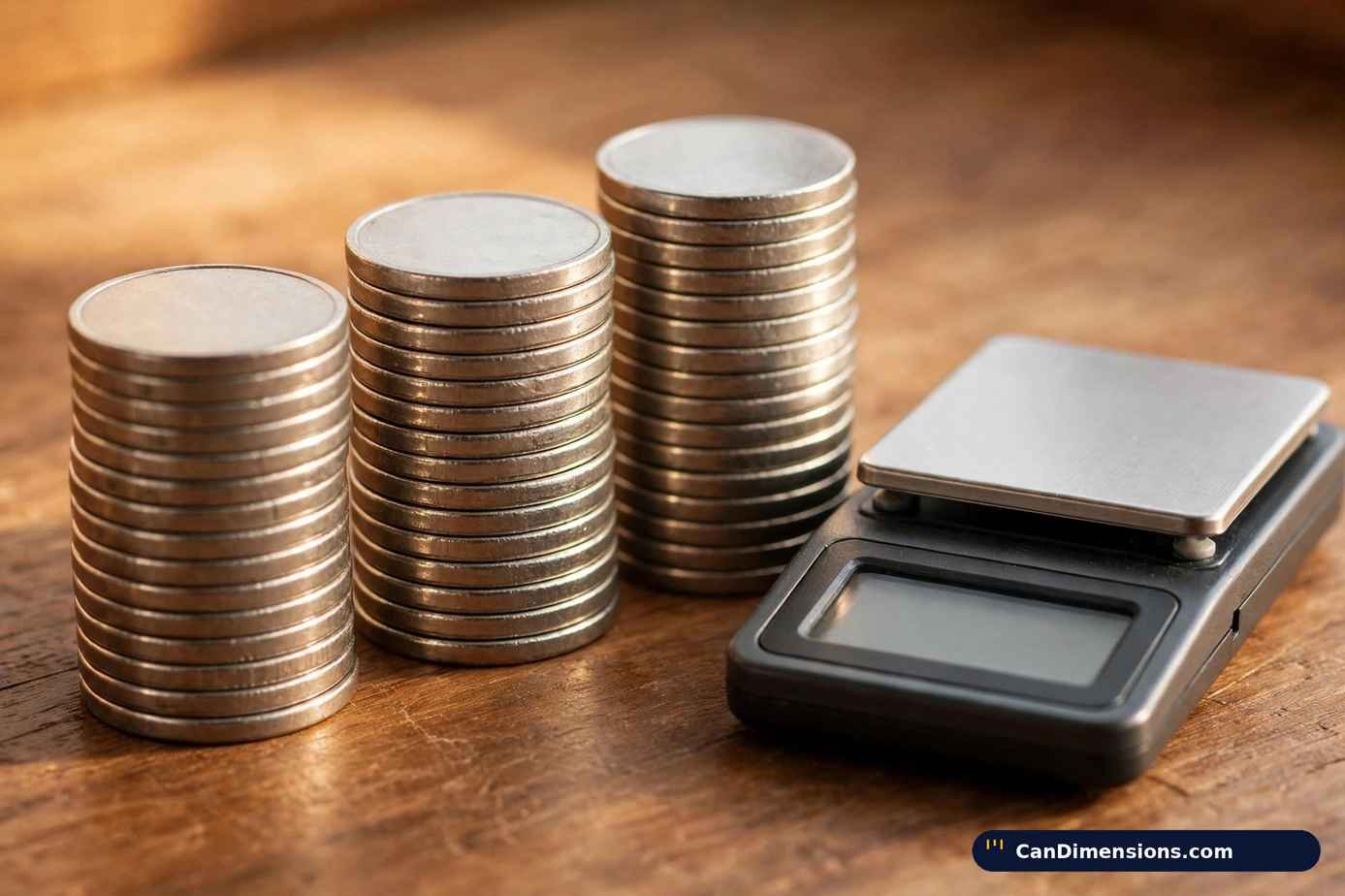
Fifteen US Quarters
Counted — exact: fifteen US quarters weigh 85.05 grams, which is 3 ounces to the hundredth. The US Mint specification for a quarter is 5.670 grams, written into 31 U.S. Code § 5112, and 15 × 5.670 g = 85.05 g against a target of 85.0486 g. That makes a fifteen-quarter stack the best pocket reference for what 3 ounces feels like — and the correction to the twelve-quarter claim above, which lands a full 0.6 oz short.
Seventeen US Nickels
Counted: seventeen nickels weigh 85.0 grams — about 3 ounces, a twentieth of a gram under. The nickel is the friendliest US coin for weight work because its Mint specification is a round 5.000 grams. Seventeen nickels make 85.0 g against the 85.05 g target — a gap of 0.06%, smaller than the wear on the coins in your pocket. Eighteen nickels make 90.0 g, a full 3.17 ounces, so seventeen is the stack to keep.
Thirty-Four US Pennies
Counted: thirty-four modern US pennies weigh 85.0 grams — about 3 ounces. Every US cent minted since 1982 weighs exactly 2.500 grams by Mint specification, so 34 of them make 85.0 g and 35 make 87.5 g. The true 3-ounce point, 85.05 g, sits a hair above the 34-penny stack. It takes a full pocket of change, but it works anywhere — and it is the third coin route on this page, after the exact quarters and the near-exact nickels.
Three-Quarters of a Stick of Butter
Counted — exact: three quarters of a US stick of butter is 3 ounces by the label itself. A stick is sold and printed as 4 ounces — 113 grams, matching the USDA record of 113 g per stick — and it carries eight tablespoon marks. Cut at the sixth tablespoon line and the piece is exactly 3 ounces, which is also exactly 6 tablespoons. Butter is the one ingredient where the weight and volume answers keep meeting: 6 tablespoons is 3 fluid ounces as a volume, and for butter alone it is 3 ounces by weight as well.
85 Millilitres of Water
Counted — exact: 85.05 mL of water weighs 85.05 grams, because 1 mL of water weighs 1 gram. Round the measure to 85 mL and the scale will still show 3 ounces. Note the contrast with the volume figure: 3 fluid ounces of water is 88.72 mL, and it weighs slightly more than 3 ounces — about 3.13 oz. The two numbers, 85.05 and 88.72, are the whole weight-versus-volume lesson in a single pair.

A 3 oz Calibration Weight
Counted — exact: a certified 3 oz calibration weight is 3 ounces by definition. These small stainless-steel weights are manufactured and certified to their stamped value within a tight tolerance, and they are sold precisely so a scale can be checked against a known mass. It is the least surprising item on the list, and the most exact — the reference the other thirteen are all, in the end, compared against.

A Tangerine
Counted: a medium tangerine is 88 grams in USDA data — about 3 ounces. The USDA reference entry for tangerines (mandarin oranges) gives one medium fruit, 2½ inches across, at 88 g (FDC 169105) — about 3.5% over the 85.05 g target, close enough that a real fruit at the small end of medium lands on the mark. It is the citrus reference this page can stand behind, and the honest replacement for the standard lime corrected above: same produce aisle, right weight class.
A Quarter Cup of Honey
Counted: a quarter cup of honey weighs 84 grams — about 3 ounces. Honey is dense: the USDA lists one tablespoon at 21 grams (FDC 169640), so the four tablespoons in a quarter cup make 84 g, about 1% under the target — and a heaped quarter cup closes even that gap. The same density is why honey is the extreme row of the liquid table below: a quarter cup of honey and a quarter cup of flour differ by nearly two ounces, which is the entire reason “ounces” without “fluid” or “weight” attached is a broken instruction.
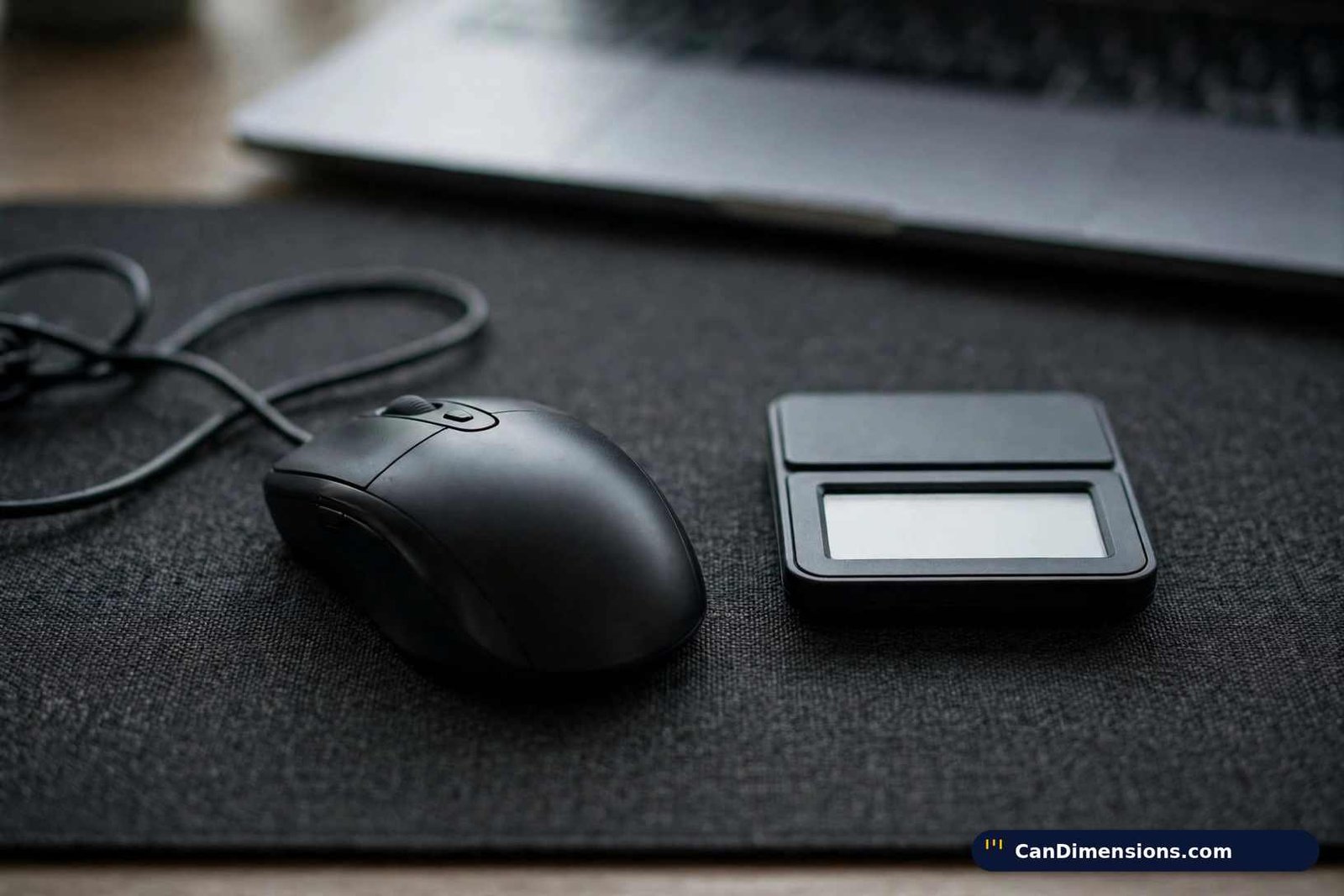
A Logitech G203 Gaming Mouse
Counted: a Logitech G203 gaming mouse weighs 85 grams by the manufacturer’s own specification — about 3 ounces. Logitech’s published spec for the G203 LIGHTSYNC is 85 g for the mouse alone, without its cable; independent lab measurement puts a real unit at 84.6 g. Either way it sits within half a gram of the 85.05 g target, which makes the mouse already on many desks the most modern reference on this list. The count is for that named model on its maker’s figure — gaming mice as a class run from under 50 g to over 120 g, so “a mouse” without a model proves nothing.
How Much Is 3 Ounces of Liquid?
When someone asks how much is 3 ounces of liquid, they are asking about fluid ounces — a volume measurement. Three fluid ounces equals 88.72 mL, which is close to but not exactly 100 mL. Practically, 3 fl oz looks like a small juice cup, a double shot glass, or roughly 6 tablespoons of any liquid. It is a common measure for salad dressings, medicine doses, baby formula and cooking oils. The TSA 3-1-1 rule allows travel liquids up to 3.4 fl oz (100 mL) per container — so a 3 fl oz bottle complies, with room to spare.
What a volume weighs, and what a weight measures out to, depends entirely on the ingredient. The table keeps the two directions separate:
| Ingredient | 3 fl oz by volume weighs | 3 oz by weight measures |
|---|---|---|
| Water | 88.7 g | 85.05 mL (just under 3/8 cup) |
| Milk | About 91 g | About 83 mL |
| Vegetable oil | About 82 g | About 92 mL |
| Honey | 126 g | About 1/4 cup |
| All-purpose flour | About 45 g | About 0.71 cup (a scant 3/4 cup) |
| Granulated sugar | About 74 g | About 0.43 cup |
| Cocoa powder | About 32 g | About 1 cup |
| Chocolate chips | About 64 g | Exactly 1/2 cup |
Read the flour row carefully, because it reverses a common claim: flour is less dense than water, not more. Three eighths of a cup of flour — which is what 3 fluid ounces means — weighs only about 45 grams, while 3 full ounces of flour by weight fill about 0.71 cup. Ingredients denser than water, like honey, run the other way: 3 fl oz of honey weighs 126 grams, nearly 4.5 ounces. This is why baking by weight is reliable and baking by “ounces” without saying which kind is not.
How to Measure 3 Ounces Without a Scale
Not everyone has a kitchen scale handy. Here are the most reliable methods to measure 3 oz of food or liquid without one — with one famous trick corrected, because the version usually printed is short by three coins.
Use a Liquid Measuring Cup
Fill to the 3 fl oz line on a standard US measuring cup. This works for water, milk, oil and other thin liquids — and it measures volume only. For a dry or solid food, the cup tells you the space it fills, not what it weighs; the table above shows how far apart those two answers can be.
Count 6 Tablespoons
Since 1 fl oz = 2 tablespoons, three fluid ounces equals exactly 6 tablespoons of any liquid. This is one of the easiest conversions to remember. For butter alone, the same 6 tablespoons are also 3 ounces by weight — the three-quarter stick of the examples section — which is why butter keeps breaking the rule that spoons measure volume.
Use the Palm Method for Proteins
For meat, fish or poultry, a 3 oz cooked portion is roughly the size of your palm, excluding the fingers — the visual trick used in many USDA portion guides. Weigh the portion after cooking if you can: meat loses roughly a quarter of its weight in the pan, so a raw piece of about 4 ounces cooks down to about 3. Judged raw against the palm, portions quietly come up short.
Stack 12 US Quarters
This heading carries the trick as it is usually taught — and as usually taught, it is wrong. Twelve quarters weigh 68.04 grams, which is 2.4 ounces: the count is three coins short. Stack fifteen quarters instead and you have 85.05 grams, exactly 3 ounces, to balance against small packages, letters and science-project loads. The corrected stack is the best scale-free weight reference on this page.
3 Ounces in Cooking and Portion Control
Three ounces is a standard serving size for proteins in US dietary guidance. Cooked chicken, fish, beef and pork are all portioned at 3 ounces in MyPlate-style meal planning, which makes it one of the most used nutritional portion weights in American kitchens: the palm-sized piece of chicken in the examples above, carrying about 26 grams of protein for breast meat, is the reference serving.
One popular tip needs its fraction repaired. Three ounces of cooked pasta is often described as “roughly ½ cup,” but the USDA puts a cup of cooked spaghetti at roughly 124–145 grams, which makes ½ cup only 62–73 grams — 2.2 to 2.6 ounces. A true 3-ounce portion of cooked spaghetti is closer to ⅔ cup. On a calorie-controlled plan, that gap is the difference between the serving you logged and the serving you ate.
Comparing 3 Ounces to Other Weights
Against 1 ounce, 3 ounces is simply triple — three slices of sandwich cheese instead of one. Against how much is 2 ounces, it is exactly one and a half times: the same handful, plus half again. Against a quarter pound, it is three quarters — one ounce short of the burger-poster weight.
The metric neighbours put it in context: 3 ounces is eight and a half times how much is 10 grams, a little over a quarter of what weighs 300 grams, and just over a sixth of how many pounds is 500 g. Small weights, same ladder — once 85.05 grams is fixed in the mind, the whole range around it becomes easier to judge.
How 3 Ounces Relates to Other Weights
Three ounces is built from the system’s own bricks: 3 × 1 ounce, 3/16 of a pound, 1,312.5 grains, and 425.2 carats. In metric it is 85.05 grams, 0.085 kilograms and 85,049 milligrams — every one of those is the same single step, multiplying or dividing the exact 28.349523125-gram ounce.
The one relative that does not belong is the troy ounce. Gold, silver and platinum are weighed in troy ounces of 31.1035 grams, so 3 troy ounces is 93.31 grams — nearly 10% heavier than the 3 ounces everywhere else on this page. Jewellery and bullion listings that say “3 oz” mean the troy figure; kitchen and postal listings mean this one.
Common 3-Ounce Myths, Checked
“Twelve quarters make exactly 3 ounces.” Checked above: twelve quarters are 68.04 g — 2.4 ounces. The exact stack is fifteen. False.
“Two large eggs weigh 3 ounces.” Two large eggs weigh about 4 ounces in the shell and about 3.5 ounces shelled. The 3-ounce eggs are two small ones. False.
“A deck of cards weighs 3 ounces.” A standard deck runs about 90–100 grams with its box and jokers — 3.2 to 3.5 ounces. Close, familiar, and over. False. (As a size comparison for a meat portion the deck is fine; as a weight it is not.)
“3 ounces is 100 mL.” 3 fl oz is 88.72 mL; 100 mL is 3.38 fl oz. Close enough for a travel bottle, wrong enough to matter in a recipe. False.
“There is a separate dry ounce.” No standards body defines one. Dry goods are weighed in the same ounce as everything else, or measured by volume. False.
“3 ounces of gold weighs 85 grams.” Gold is weighed in troy ounces: 3 troy ounces is 93.31 grams. False — and the most expensive mistake on this list.
Question’s
How much is 3 ounces in cups?
As a volume, 3 fluid ounces is exactly 3/8 cup. As a weight, the ingredient decides: about 0.71 cup of flour, exactly 1/2 cup of chocolate chips, or just under 3/8 cup of water.
Is 3 oz half a cup?
No. Half a cup equals 4 fluid ounces. Three ounces is slightly less — 3/8 of a cup as a volume.
How much does 3 oz look like?
A palm-sized portion of cooked chicken, three quarters of a stick of butter, a tangerine, or a stack of fifteen quarters. All fit comfortably in one hand.
How much is 3 ounces in mL?
88.72 mL as a volume (3 fluid ounces). By weight, 3 ounces of water is 85.05 mL — the two answers differ because the units do.
How do I measure 3 ounces of water?
Fill a measuring cup to the 3 fl oz line, count out 6 tablespoons, or weigh 85.05 g on a scale if it is the weight you need.
How much chicken is 3 oz?
A cooked portion about the size of your palm — roughly half of a small breast at the USDA reference size — with about 26 grams of protein for breast meat.
How much is 3 ounces of liquid?
3 fluid ounces = 6 tablespoons = 88.72 mL = 3/8 cup. A small amount: a double shot glass, or a small juice cup.
How to convert cups to ounces?
For fluid ounces, multiply cups by 8 — 0.5 cup × 8 = 4 fl oz — and divide by 8 to go back. For weight, there is no single conversion; the ingredient decides.
How to measure 3 oz of food without a scale?
Stack fifteen quarters for an exact weight reference, use the palm method for proteins, or count 6 tablespoons for liquids.
How many grams is 3 oz?
85.05 grams, exactly — 3 × 28.349523125 g, rounded to two decimals.
How to measure 3 oz of food?
A kitchen scale is the exact route. Without one, use the palm method for proteins, tablespoons and cups for liquids, and the fifteen-quarter stack for small items.
Is 3 ounces 100 ml?
No. 3 fl oz = 88.72 mL. It takes 3.38 fl oz to equal 100 mL — close, but not interchangeable in a precise recipe.
How many tablespoons in 3 oz?
Six tablespoons as a volume (3 fl oz). By weight it depends on the ingredient — though for butter, 6 tablespoons is exactly 3 ounces too.
How many cups equal 3 oz?
3/8 cup (0.375 cup) as a volume — about 6 tablespoons. By weight, the ingredient decides.
How to visualize 3 ounces?
Think of fifteen stacked quarters, three quarters of a butter stick, a tangerine, or 85 mL of water in a small glass. All are everyday items at about 3 oz.
Does 1 cup equal 1 ounce?
No. One cup is 8 fluid ounces by volume, and by weight a cup of water is about 8.35 ounces while a cup of flour is about 4.25 ounces.
Final Thoughts
Three ounces is exactly 85.05 grams — three sixteenths of a pound — and once the fluid ounce is kept in its own column, every version of the question has a clean answer: 88.72 mL of volume, 3/8 of a cup, 6 tablespoons. The verified objects make it tangible: a palm-sized piece of chicken, a labelled bar of soap, the spice in a 3 oz jar, a tangerine, and a stack of coins that hits the figure exactly. The three famous failures — the large eggs, the twelve quarters and the lime — are worth remembering too, because they are the claims most likely to be repeated.
Keep one reference within reach and the weight stops being abstract. Fifteen quarters in a pocket will tell your hand what 3 ounces is more honestly than any chart — the chart above is just there to prove they were telling the truth. A golf ball will not do the job, by the way: the rules cap a ball at 45.93 grams (1.62 oz), so even two of them overshoot to about 3.24 ounces — keep one as the halfway mark instead.