9 Inches: 13 Things with Pictures That Are 9 Inches Long
Nine inches turns up everywhere — in the kitchen drawer, on the bookshelf, in the toolbox — yet most people cannot picture it on demand. So how big is 9 inches? It is exactly 22.86 centimetres, three quarters of a foot, and it is the size of a whole class of everyday objects once you know where to look.
The catch is that the internet’s favourite 9-inch examples are not all honest. Every object below was checked against a maker specification, an official standard or a reference database before it was counted, and three famous examples fail that check — they stay on the page under their original headings, corrected, so nobody repeats them.
You will get the exact conversions first, then 13 verified things that are 9 inches long, a ruler-free measuring section with the arithmetic done properly, a comparison against the neighbouring sizes, and short answers to the questions people actually ask about this length.
How Long Is 9 Inches?
Nine inches is exactly 22.86 centimetres (228.6 millimetres, 0.2286 metres). In imperial terms it is 0.75 feet — three quarters of a foot — or exactly a quarter of a yard. Lay a standard 12-inch ruler down and cover its last quarter: everything left uncovered is 9 inches.
That makes 9 inches a useful in-between size. It is longer than a sheet of letter paper is wide (8.5 inches), shorter than that same sheet is long (11 inches), and close to the height of an ordinary hardcover book. From your kitchen drawer to your dining table, things that are 9 inches long surround you daily — the rest of this page names the ones that genuinely measure up.
Common Things That Are 9 Inches Long
Every example under this heading was checked before it was counted. Thirteen pass — some exactly, on a maker’s specification or an official size class, and some as honest “about” matches where the corrected basis is stated in the section. Three of the original examples fail, and they stay below as corrected warning sections, clearly marked, so nobody repeats them.
| Thing | Verified size | Counted? |
|---|---|---|
| Standard dinner plate | 9 in diameter (named maker size) | Yes — corrected basis |
| Large tablet device | 9.7 in screen diagonal; body 9.4 in tall | No |
| Three dollar bills lined up | 7.83 in by widths; 18.42 in by lengths | No |
| Two smartphones stacked vertically | About 11.6 in (current models) | No |
| Standard butter knife or table knife | Dinner knife exactly 9 in (flatware spec) | Yes — corrected basis |
| Small to medium banana | 9 in only at the extra-large class | Yes — corrected basis |
| A 9-inch pie plate | 9 in diameter (Pyrex) | Yes |
| A 9-inch round cake pan | 9 in across the top (Wilton standard) | Yes |
| A 9-inch square baking pan | 9 in sides (Wilton standard) | Yes |
| A 9 × 5 inch loaf pan | 9 in long | Yes |
| A 9-inch cast iron skillet | 9 in (Lodge maker’s size) | Yes |
| A 6 × 9 inch book | 9 in tall (standard trim size) | Yes |
| A 9-inch paint roller cover | 9 in (the standard roller size) | Yes |
| A 9-inch torpedo level | 9 in (Stanley maker’s spec) | Yes |
| A 9-inch embroidery hoop | 9 in diameter | Yes |
| 9-inch knitting needles | 9 in long | Yes |
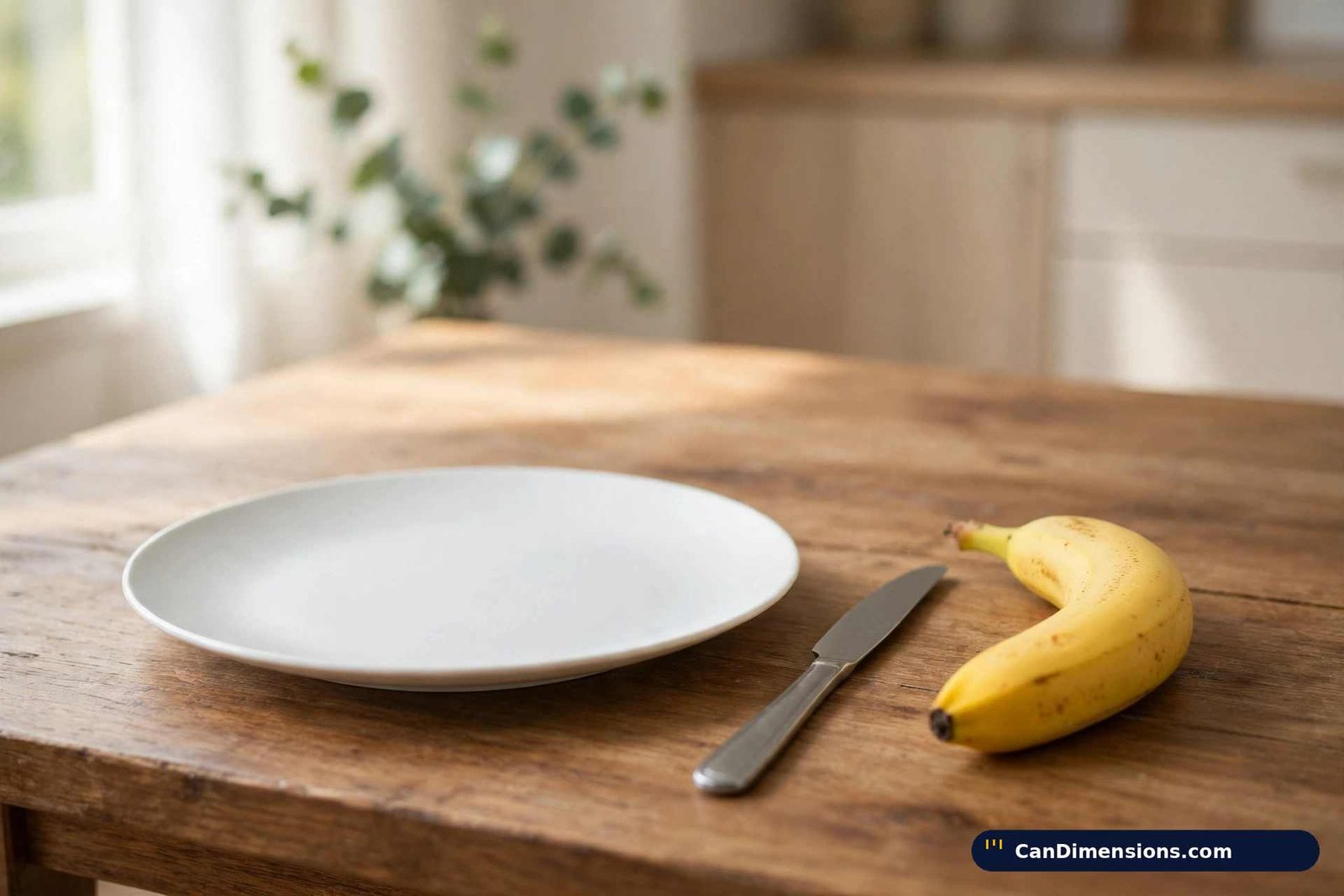
Standard Dinner Plate
Counted: on a corrected basis. Genuine 9-inch dinner plates exist and are sold by name — American Metalcraft’s Jane Collection, for example, lists a melamine dinner plate at exactly 9 inches in diameter, and commercial spec sheets carry 9-inch dinner plates as a standard line. If you own a plate sold as a 9-inch dinner plate, it is a true 9-inch reference.
What needs correcting is the claim that most dinner plates measure exactly 9 inches and that 9 inches is the classic size in almost every American household. The common modern dinner plate is bigger — most sold today run 10 to 10.5 inches across. The 9-inch plate is the smaller, older place-setting size: real, standard, and easy to find, but no longer the default. Check the size printed on the box or the maker’s page before you trust a plate as your reference.
Large Tablet Device
Not counted: the numbers do not land on 9 inches in any direction. The classic 9.7-inch iPad is the example usually given, but 9.7 inches is the size of its screen measured corner to corner — the diagonal. Apple’s own technical specifications for that iPad give the device itself as 9.4 inches tall and 6.6 inches wide. So the tablet is not 9 inches tall, not 9 inches wide, and its one famous figure, 9.7, is a diagonal, which is not a length you can lay against anything.
A tablet is still a decent rough guide — a 9.7-inch iPad stands a little under half an inch taller than 9 inches — but “roughly” is all it is. It is kept here as a warning because it is probably the most repeated 9-inch claim on the internet, and it is wrong in three different ways at once.
Three Dollar Bills Lined Up
Not counted: the arithmetic fails both ways. A US bill is a fixed, official size — the Bureau of Engraving and Printing makes every denomination 6.14 inches long and 2.61 inches wide. Line three bills up along their widths and you get 3 × 2.61 = 7.83 inches, well short of 9. Line them up along their lengths and you get 3 × 6.14 = 18.42 inches, more than double. There is no way to arrange three whole bills that makes 9 inches.
Used honestly, though, one bill is still a fine pocket ruler, because its two dimensions bracket 9 inches neatly: a bill’s length plus its width is 6.14 + 2.61 = 8.75 inches (just under), and one and a half bill-lengths is 9.21 inches (just over). The bill is useful in a second way, too — a single note weighs about a gram, which is why it anchors our guide to things that weigh 1 gram. Ten bills together weigh about 10 grams, the subject of how much is 10 grams, and you would need roughly 85 of them — about 85 grams — to reach how much is 3 ounces.
Two Smartphones Stacked Vertically
Not counted: this claim is built on a phone size that stopped existing about a decade ago. The usual version says modern smartphones average 4.5 to 5 inches long, so two stacked make roughly 9 to 10 inches. Today’s phones are much taller than that: Apple’s iPhone 16 stands 5.81 inches tall and Samsung’s Galaxy S24 stands 5.79 inches. Stack either pair vertically and you are looking at about 11.6 inches — closer to a foot than to 9 inches.
One modern phone on its own is a better mental marker for about 6 inches than for 9. If a page tells you two phones equal 9 inches, it is quoting the phone sizes of the early 2010s, and every estimate built on it will run short by more than two inches.
Standard Butter Knife or Table Knife
Counted: on a corrected basis — the 9-inch piece in the cutlery drawer is the dinner knife, not the butter knife. Flatware specification sheets list dinner knives at exactly 9 inches: one major food-service pattern’s spec sheet gives its dinner knife, in both hollow-handle and solid-handle versions, as 9 inches (22.9 cm), and place-size dinner knives generally run about 9 to 9.25 inches. Lay a dinner knife from a standard place setting against anything and you have a true 9-inch measure.
The correction is about the heading’s other half. A true butter knife — the small individual spreader — is a much shorter tool, typically around 5 to 7 inches. What most households call the butter knife is really the dinner knife doing double duty, and that knife is the 9-inch one. So the example survives, but only once the right knife is named.
Small to Medium Banana
Counted: on a corrected basis, and the correction matters: a banana only reaches 9 inches at the top of the size scale, not in the middle of it. The USDA’s FoodData Central entry for bananas sorts the fruit into length classes — small is 6 to just under 7 inches, medium is 7 to just under 8 inches, large is 8 to just under 9 inches, and extra large is 9 inches or longer. A banana that measures exactly 9 inches is the smallest extra-large banana, not a small or medium one.
So keep the banana as a reference, but shop for the right one: the long banana at the top of the bunch, not the average fruit. For scale, the USDA’s medium banana weighs 118 grams — a little over what weighs 100 grams — and the extra-large fruit that reaches 9 inches weighs about 152 grams.
A 9-Inch Pie Plate
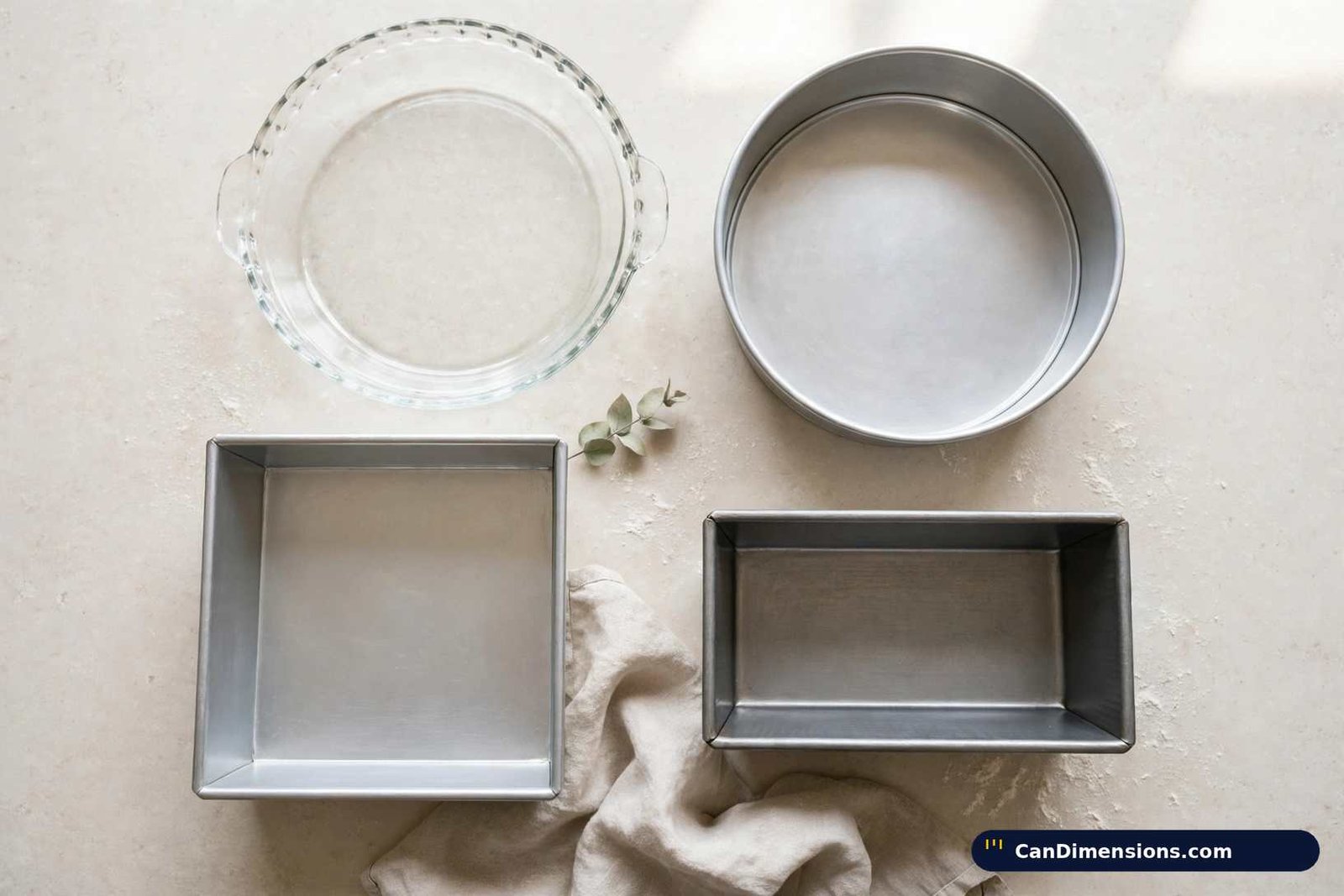
Counted: exactly, on the maker’s own size. The standard glass pie plate — Pyrex’s 9-inch pie plate is the reference example — is made and sold at 9 inches across. Pie plates are measured across the top, rim to rim, and the 9-inch size is the one nearly every American pie recipe is written for.
It is one of the most reliable references on this list because the size is the product’s name, printed by the maker, and because the plate is a fixed circle: unlike a banana, it cannot be a little longer or shorter than its stated size. If a 9-inch pie plate is in the cupboard, your 9 inches is settled.
A 9-Inch Round Cake Pan
Counted: exactly, as a standard pan size. The 9-inch round is one of the core sizes on Wilton’s cake pan charts and in every pan conversion table — 9 inches across the top, 63.6 square inches of base, holding about 8 cups. Pans are sized by their inside measurement at the top rim, which is the dimension recipes depend on.
The 9-inch round and its square sibling below are the two pans most layer-cake recipes assume. Because the size is a manufacturing standard rather than a natural object, a pan sold as 9-inch is 9 inches in a way fruit and hand spans never are.
A 9-Inch Square Baking Pan
Counted: exactly, as a standard pan size. Wilton’s charts list the 9-inch square alongside the 9-inch round, and it is the standard pan for brownies, cornbread and coffee cakes — 9 inches on every side, 81 square inches of base.
The square pan is a handy reference because it gives you 9 inches in two directions at once and a straight edge to measure against, which a round pan cannot do. Recipes swap it against the 9-inch round almost one-for-one, since their base areas are close.
A 9 × 5 Inch Loaf Pan
Counted: exactly — the pan is 9 inches long. The 9 × 5 loaf pan is the larger of the two standard loaf sizes (the other is 8.5 × 4.5), and its name is its inside measurement at the top: 9 inches long by 5 inches wide. Wilton sells its standard loaf pan at exactly this size, and standard bread and meatloaf recipes are written for it.
A loaf pan earns its place here because the 9 inches is the long dimension you actually use — it is the length of the loaf. If a recipe’s loaf comes out of a 9 × 5 pan, the finished bread itself is a 9-inch reference for the few minutes before it is sliced.
A 9-Inch Cast Iron Skillet
Counted: exactly, on the maker’s stated size. Lodge, the largest American cast-iron maker, sells a 9-inch skillet (model L6SK3) and lists the size as 9 inches — 22.86 cm — across the top of the pan, the same conversion this page started with. Skillets are sized by that top diameter, handle excluded.
Cast iron is an unusually honest reference because the pan is cast in a mould: every unit of the model comes out at the stated size. The 9-inch skillet sits in the middle of Lodge’s range, between the small 8-inch and the big 10.25-inch everyday pan, and it is the size most often sold for two-person cooking.

A 6 × 9 Inch Book
Counted: exactly — the book stands 9 inches tall. Book sizes are given width first, so a “6 × 9” book is 6 inches wide and 9 inches tall. That trim size is the standard US trade size: Amazon KDP lists 6 × 9 inches among its standard paperback trims and calls it the most common, and IngramSpark puts general fiction at the same 6 × 9 (152 × 229 mm).
This is the most available reference on the whole list. Any standard American hardcover or trade paperback on a shelf is very likely a 9-inch-tall object, made to a printer’s specification rather than grown or estimated. Stand one upright and you have 9 inches, spine to top edge.

A 9-Inch Paint Roller Cover
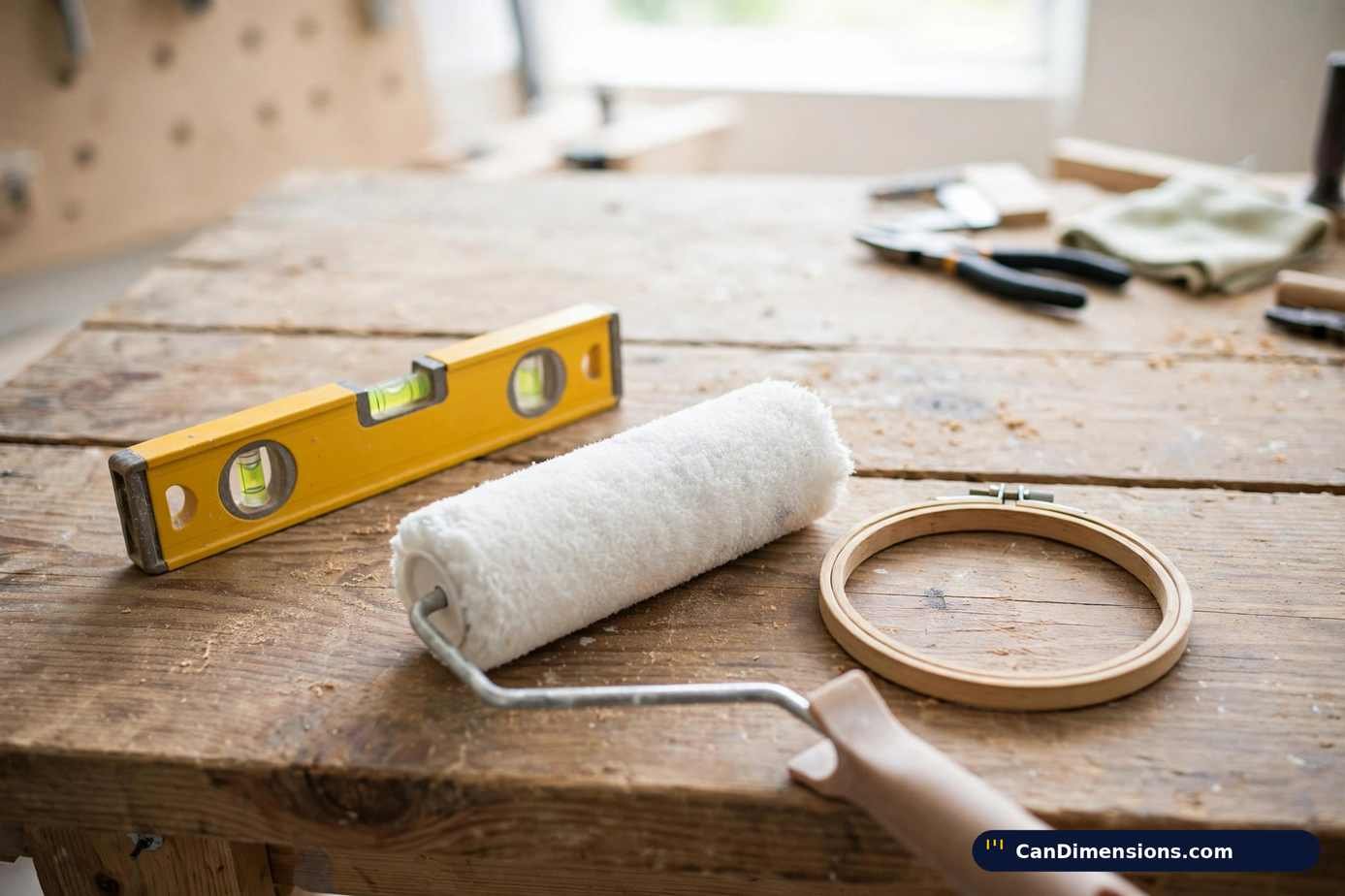
Counted: exactly — 9 inches is the standard roller size. Roller covers are sold by their length, and 9 inches is the default for walls and ceilings: Wooster’s professional Super/Fab cover (R239-9) is specified at 9 inches, Purdy’s main lines are built around the same 9-inch size, and every standard roller frame is made to fit it.
Mini rollers run 4 to 6 inches and wide rollers 18, but the cover in the tray at any ordinary painting job is the 9-inch one. It is a manufactured size, consistent from brand to brand, which makes it a reference you can buy for a few dollars and keep.
A 9-Inch Torpedo Level
Counted: exactly, on the maker’s specification. The torpedo level is the short level in every toolbox, and its standard length is 9 inches: Stanley’s own product page describes its FatMax torpedo level (43-605) as “a 9-Inch level,” and Stanley’s catalogue lists its standard torpedo models at 9 inches (229 mm).
A level is a fitting reference for a measurement page — the tool exists to be exact, and its body is machined to its stated length. If you own one tool that is exactly 9 inches long, it is probably this one.
A 9-Inch Embroidery Hoop
Counted: exactly, as a standard stocked size. Embroidery hoops are sold by diameter in whole-inch sizes, and 9 inches is one of the standard steps in every maker’s range — retail specifications list 9-inch hoops at 9 inches across (listed as 9 inch / 23 cm). The hoop’s stated size is its working diameter, the circle that holds the fabric.
Hoops run from tiny 3-inch frames up to 14 inches and beyond, and the sizes in between are as regular as pan sizes. A 9-inch hoop is a true circle of a stated diameter, which makes it a better reference than most round objects in a kitchen.
9-Inch Knitting Needles
Counted: exactly, as a standard needle length. Straight single-point knitting needles are made in a small set of standard lengths that run from 9 inches up to 14, and 9 inches is the short standard — the length sold in beginner and bamboo needle sets (one widely sold 36-piece bamboo set is built entirely around 9-inch single-point needles).
One honest limit: the big aluminium brands run longer — Boye’s straight needles are 10 and 14 inches — so the 9-inch needle is the bamboo and beginner-set standard rather than every maker’s. Check the length printed on the packet; where it says 9 inches, the needle is exactly that, tip to end knob.
How to Measure 9 Inches Without a Ruler
Start with the dinner knife above: a place-setting dinner knife is a 9-inch object, so the simplest ruler-free measure is already in the cutlery drawer. The 9-inch pie plate, the 6 × 9 book and the torpedo level all work the same way — find one verified object and measure against it directly.
Hand span technique: an adult hand stretched fully, thumb tip to pinky tip, commonly spans somewhere in the 7-to-9-inch range — which is exactly why you must measure your own hand once against a real ruler before trusting it. If your span turns out to be 9 inches, you own a permanent personal ruler; if it is 8, you know to add an inch.
Dollar bill method: forget lining up three bills — the arithmetic for that is corrected in the bill section above. The honest version brackets the target: one bill’s length plus one bill’s width is 8.75 inches, just under 9, and one and a half bill-lengths is 9.21 inches, just over. Anything that falls between those two marks is, to everyday accuracy, 9 inches.
Finger width trick: an average index finger is about 3/4 inch wide, so twelve finger widths laid side by side make about 9 inches. It is the roughest method here — fingers vary more than hands do — but it works for a quick estimate when nothing else is at hand.
9 Inches: Quick conversion formula
How big is 9 inches in different units? In the metric system, 9 inches equals 22.86 centimetres exactly. For those using meters, that is 0.2286 meters. In feet, 9 inches converts to 0.75 feet, or three-quarters of a foot.
Quick conversion formula: multiply inches by 2.54 to get centimetres, so 9 × 2.54 = 22.86 cm. To get millimetres, multiply inches by 25.4 (9 × 25.4 = 228.6 mm). To get metres, divide centimetres by 100. To go from inches to feet, divide by 12 (9 ÷ 12 = 0.75 ft). Simple math, powerful results for understanding 9 inches globally.
9 Inches Conversion Chart (CM, MM, Feet and Meters)
The formula section above gives the method; this chart is the same 9 inches stated in every unit a reader is likely to need, so it can be read off directly.
| Unit | 9 inches equals |
|---|---|
| Centimetres | 22.86 cm |
| Millimetres | 228.6 mm |
| Metres | 0.2286 m |
| Feet | 0.75 ft |
| Yards | 0.25 yd |
The millimetre figure is the one people stumble on, because 228.6 mm is hard to picture on its own. It helps to anchor the small end of the scale separately — our guide to 2 mm shows what a single small metric unit looks like against coins and card, and 9 inches is simply 114.3 of those stacked end to end.
Is 9 Inches Big?
It depends on what it is the size of, and the honest answer is: middling. Nine inches is three quarters of a foot — large for a phone or a sandwich, small for a shelf or a scarf. It is roughly the size of the things you hold in two hands: a hardcover book’s height, a pie plate, a skillet’s cooking surface.
Two paper comparisons fix it in most people’s minds. A sheet of US Letter paper is 8.5 inches wide and 11 inches long, so 9 inches sits between the two edges of the most familiar rectangle in American life — half an inch more than the short side, two inches less than the long side. Anything described as 9 inches is, to a first approximation, “about a page wide, and then a little finger’s width more.”
9 Inches vs 7, 10 and 12 Inches: Neighbouring Sizes Compared
Nine inches makes most sense next to its neighbours. Seven inches (17.78 cm) is the size of a small tablet’s screen class or a paperback’s height in smaller formats; 10 inches (25.4 cm) is the modern dinner plate and the big everyday skillet; 12 inches (30.48 cm) is the foot itself — the ruler on the desk.
| Length | Centimetres | Everyday anchor |
|---|---|---|
| 7 inches | 17.78 cm | Small paperback height class |
| 9 inches | 22.86 cm | 6 × 9 book, 9-inch pie plate |
| 10 inches | 25.4 cm | Modern dinner plate |
| 12 inches | 30.48 cm | A full foot — the standard ruler |
The step from 9 to 12 is the one worth memorising: 9 inches is exactly three quarters of the way there, and going the other direction, 3 inches is exactly one third of 9 inches — three of those short measures laid end to end land on 9 inches precisely.
Almost 9 Inches: Look-Alikes That Miss the Mark
Some famous objects get quoted as 9 inches and are not — close enough to fool an estimate, wrong enough to matter. A sheet of US Letter paper is 8.5 inches wide: half an inch short, every time, no matter how often it is called “about 9.”
A bowling ball can never reach 9 inches. The USBC’s equipment specifications cap a tenpin ball’s diameter at 8.595 inches (the minimum is 8.500), so the largest legal ball is still four tenths of an inch short of 9. In the other direction, a men’s basketball overshoots: a size 7 ball is 29.5 inches around, which works out to about 9.4 inches across — nearly half an inch too big.
And the tablet from the examples list belongs here too: the 9.7-inch iPad’s screen diagonal sounds like a 9-inch-class figure, but the device itself stands 9.4 inches tall. Near 9 inches is a crowded neighbourhood; the counted list above is the part of it that is exactly 9.
Question’s
What can you compare 9 inches to?
Compare it to things that are verified at 9 inches: a 9-inch pie plate or dinner plate (in the named 9-inch size), a dinner knife, a 6 × 9 inch book standing upright, a 9-inch paint roller cover or a torpedo level. One comparison to avoid: three credit cards lengthwise. A credit card is 3.37 inches long under the ISO standard, so three of them make 10.1 inches, not 9.
How to measure 9 inches without a ruler?
Use a verified object first — a dinner knife, a 9-inch pie plate or a 6 × 9 book. With a dollar bill, bracket it: a bill’s length plus its width is 8.75 inches and one and a half lengths is 9.21 inches, so 9 inches falls between the two marks. A hand span works only after you have measured your own span once against a real ruler.
What shoe size is 9 inches long?
Shoe sizing is not standardised, so treat any single answer with suspicion — published foot-length charts disagree with each other. For a foot that measures 9 inches heel to toe, the charts put you at roughly a US men’s 5 to 6 or a US women’s 6.5 to 7.5, depending on the chart and the brand. It is not a youth size 2–3: a 9-inch foot sits at the very top of children’s sizing or the bottom of adult sizing. Always go by the brand’s own chart and the centimetre figure, 22.86 cm.
What unit is 9 inches long?
Nine inches is a length in the imperial and US customary systems — the inch is defined as exactly 2.54 centimetres, and 12 inches make a foot. The same length in metric is 22.86 centimetres or 228.6 millimetres. “9 inches” can describe any dimension — a diameter, a height, a length — which is why this page states which dimension is meant for every example.
What size is a 9 inch?
It is a standard manufactured size across several product families: 9-inch pie plates, cake pans and skillets in the kitchen; 6 × 9 inch books in publishing; 9-inch roller covers and torpedo levels among tools; 9-inch embroidery hoops among craft supplies. When a product is sold as “9 inch,” the figure is the maker’s stated size for its main dimension — a pan’s top width, a book’s height, a hoop’s diameter.
How big is 9 inches in m?
Nine inches is 0.2286 metres, exactly — 22.86 centimetres. To picture it against a metre: it is just under a quarter of a metre (22.86%), not a fifth — a fifth of a metre would be 20 cm, a full inch shorter. Most metric users find centimetres easier at this size: call it 23 cm and you are within a millimetre and a half.
Final Thoughts
Understanding how long 9 inches is becomes simple once it is attached to objects that genuinely measure 9 inches — and just as important, once the famous near-misses are retired. The tablet is 9.4 inches tall wearing a 9.7-inch diagonal, three dollar bills make 7.83 or 18.42 inches but never 9, and two modern phones overshoot by more than two inches. The honest references are quieter ones: the pie plate, the dinner knife, the book, the skillet.
Keep one of them where you can reach it and the size never needs guessing again. A 6 × 9 book on the shelf, a torpedo level in the drawer, or the standard paint roller in the garage — each one is exactly 9 inches in its working dimension, verified against the people who make them, and ready to measure against anything else.